An email address is the only asset a visitor can leave behind. Most people who land on your store leave without buying — that traffic cost you money to acquire, and the email signup is the one mechanism that turns some of it into something you own. Paid channels rent you attention; your list is the channel where the margin doesn’t leak out to an ad platform.
Which makes it strange how little most stores are willing to offer for one.
Australian Shopify stores we audited in July 2026 either had no detectable email capture at all, or asked for the address with nothing specific in return — no discount, no dollar figure, no concrete first-order reason to hand it over.
What the signups actually say
These are verbatim, from live Australian storefronts we audited during July. Stores not already the subject of a published CartLift teardown are anonymised — the point is the pattern, not the pile-on.
footwear brand (published teardown): “Stay in the loop, with exclusive offers and product previews” — the loop is the product.
designer fashion boutique: “For the girls who always want to know what’s new first. Consider this your early access.” — early access to being marketed to.
apparel brand (our public sample teardown): no email capture form, popup or email platform detected on the pages we sampled. The most common leak has a rarer, more expensive cousin: not asking at all.
Read them again as a shopper. Every one of these asks you to opt into more marketing, and offers you — more marketing. “Be the first to know” is a real benefit for perhaps the hottest hundred fans a brand has. Everyone else does the arithmetic instantly: inbox noise, in exchange for nothing.
Why the generic ask costs real money
The damage compounds in three steps.
1. Fewer addresses captured
A signup form with no reason attached is a form that only your existing fans fill in. The shopper who was on the fence — the one email marketing exists to recover — is exactly the one a vague ask loses. A specific first-order incentive gives the undecided visitor a reason to act now, and “now” is the entire game on a first visit, because almost nobody comes back on their own.
2. The addresses you do capture are worth less
A “stay in the loop” subscriber signed up out of curiosity. A “$15 off your first order” subscriber signed up with a purchase already half-formed in their mind, and your welcome email arrives holding the voucher that finishes the thought. The incentive doesn’t just capture more addresses — it captures addresses closer to a transaction.
3. Every downstream flow starves
Abandoned-cart recovery, welcome sequences, back-in-stock alerts, win-backs — every automation the ecommerce playbook is built on runs off the list. A weak capture step quietly halves the audience for all of them at once. It is the single upstream leak that makes four downstream tools underperform, which is why we weight it so heavily in audits.
The objection: “discounts train customers to wait for discounts”
Sometimes true, and worth taking seriously — premium brands in particular have good reasons to protect price integrity. But the choice isn’t between a discount and nothing. The requirement is only that the offer be specific. Stores protective of margin can trade first access to genuinely limited drops, a dollar-value perk like free express shipping with a stated threshold, a useful piece of content (sizing guides convert remarkably well in apparel), or entry into something with a date on it. What doesn’t work is the empty version: a promise of “offers” that never names one.
One store fixed it while we were watching
Between our first audit pass in mid-July and a re-check on 27 July, one of the 25 replaced a bare signup with a rewards-club pitch carrying a concrete “$15 off your first order” hook. We have no inside knowledge of their numbers — but the change itself is the point we most want to make: this is not a replatforming project. It is a copy change and a voucher code, shippable in an afternoon, and one of the highest leverage-to-effort ratios anywhere on a Shopify store.
Audit your own capture in ten minutes
- Open your store in a private window, on your phone. Wait for the popup. If none appears, scroll the homepage and one product page looking for any signup module at all.
- Write down exactly what it offers. Not what you think it offers — the words on the screen.
- Apply the stranger test: would someone with no attachment to your brand hand over their email for that sentence?
- Check the footer signup says the same thing as the popup. Mismatched incentives in two placements is the same disease as contradictory free-shipping thresholds — two answers to one question.
- Sign up with a fresh address. Time how long the welcome email takes and whether it delivers the promised incentive without being asked. A promised voucher that never arrives is worse than no promise.
- Check the incentive maths: the offer should clear at your average order value, not undercut it. “$15 off over $150” is margin-safe in a way “15% off anything” is not.
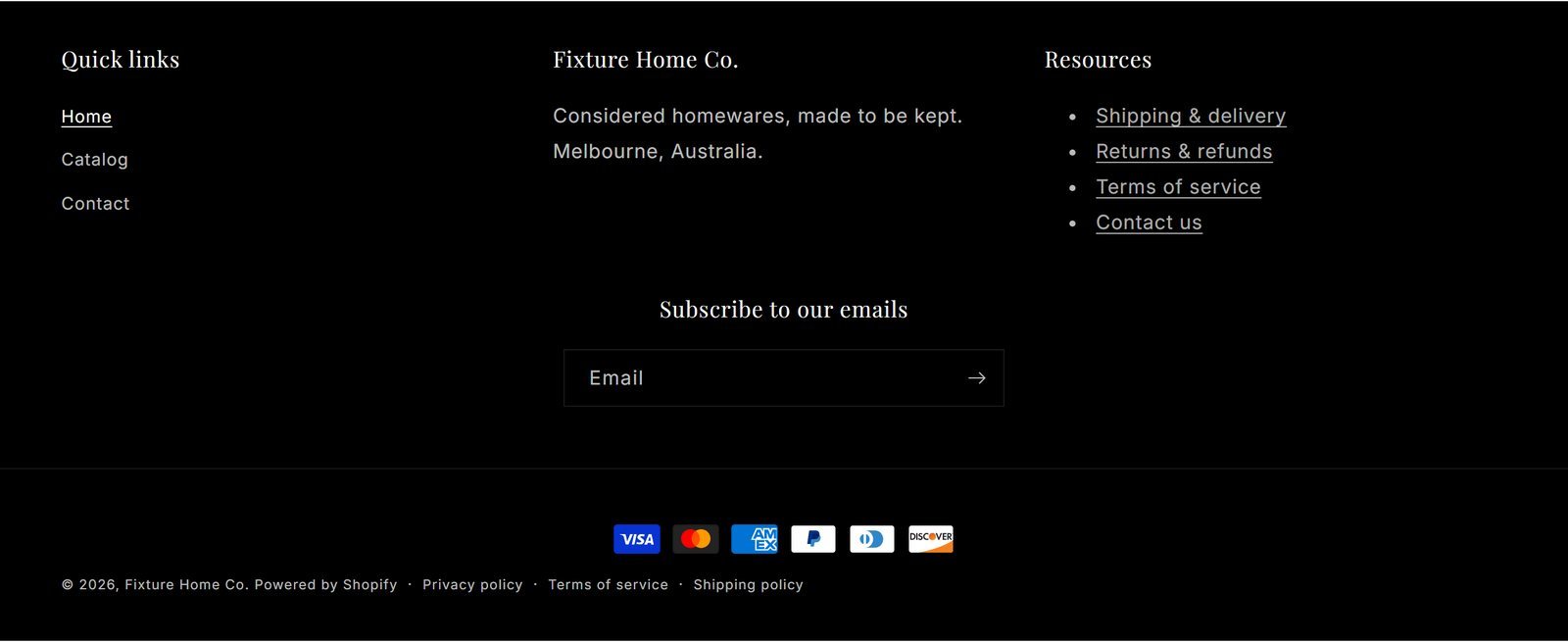
BeforeThe form exists. The reason to use it doesn’t.
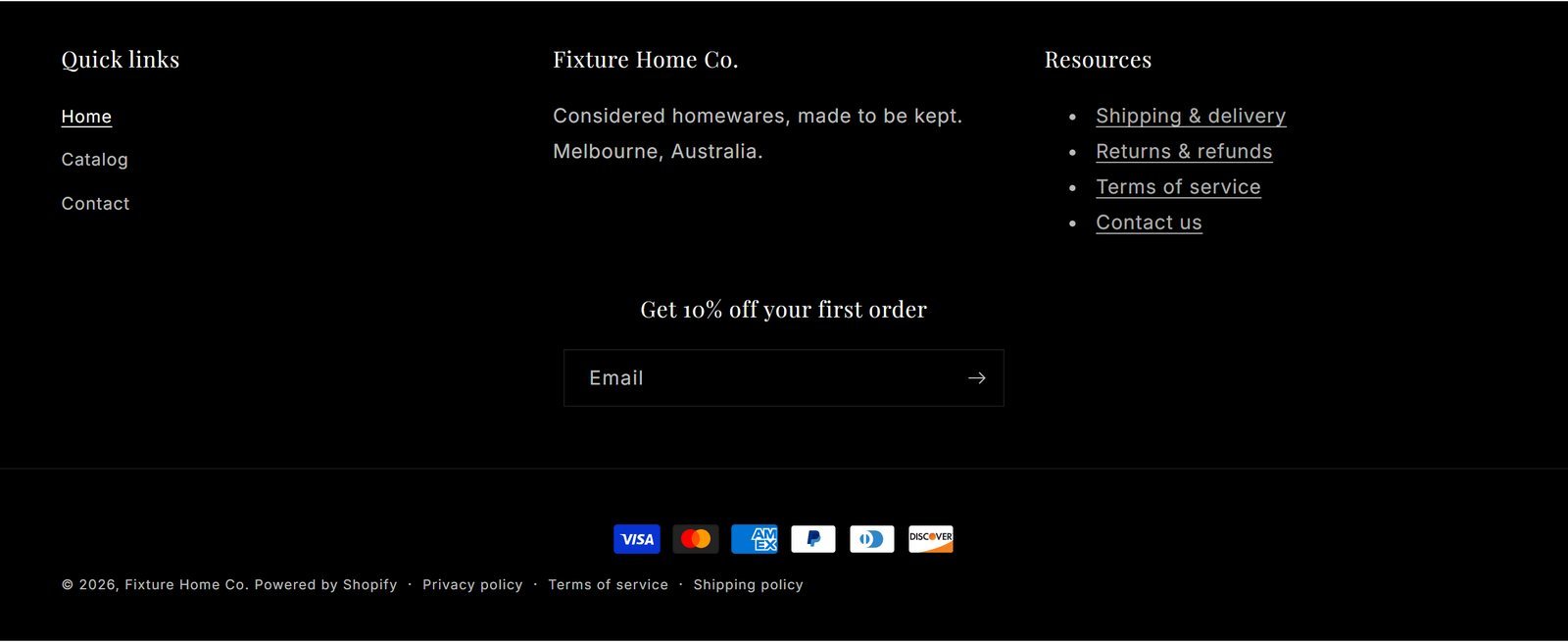
AfterSame form, same placement — the ask now answers “why would I?”
About these screenshots: taken from a demonstration store we built and control, so the defect and its fix can be shown on the identical page. It is not a real merchant’s shop — the stores cited above are.
The fix, in order
1. Pick the incentive your margin can carry
A dollar figure with a minimum spend is the safest default. Percentage offers are easier to say and harder to control. Non-discount perks work if — and only if — they are specific.
2. Say it in the popup, the footer, and the welcome email — identically
One sentence, three placements, zero variation. The moment two placements disagree, you have created the contradiction problem on top of the incentive problem.
3. Deliver instantly
The welcome email with the code should arrive before the shopper finishes the session. Delay kills the half-formed purchase the incentive created.
4. Cap it, date it, and measure one number
Single-use codes, a validity window, and one metric: signups that convert to a first order inside 30 days. That number tells you whether the incentive is acquiring customers or just funding your existing fans’ next purchase.
The honest caveats
Popups annoy people; a badly timed one costs more than a weak incentive, so fire on exit intent or after meaningful scroll, never on arrival. Discount-led capture genuinely doesn’t suit every brand — the alternative is a specific non-discount offer, not a vague one. And email capture is one leak among several: the same 25 audits found no reviews anywhere on the buying path on 16 stores and contradictory shipping messages on 13. The stores leaking here are usually leaking elsewhere, and sequencing the fixes is most of the value of an audit.
We’ll map the leaks across your whole store, not just this one.
A 40-point revenue-leak teardown — speed, product pages, trust, email flows, SEO, checkout friction — delivered as a prioritised fix roadmap in 48 hours. Fixed A$695, no retainer. Fewer than 5 actionable fixes and we refund in full.
Not sure whether any of this applies to your store? Get a free scan — we render your storefront in a real browser and email you what we find. No card, no call.
or read the full sample first →