Threadheads
threadheads.com
This report's evidence is dated 20 July 2026. We re-checked the live storefront twelve days later, in a real browser, and publish the result whether or not it flatters us:
- L-01 (Critical) — no longer applies. Threadheads now runs Okendo on the product page:
5.0 from 486 reviews, a rating summary above the fold, and
AggregateRatingin the page's structured data. - L-03 (High) — no longer applies. Klaviyo and Postscript are both loading, and there is a working email capture in the footer.
- T-02 (Medium) — no longer applies. The product page carries a "You may also like" row.
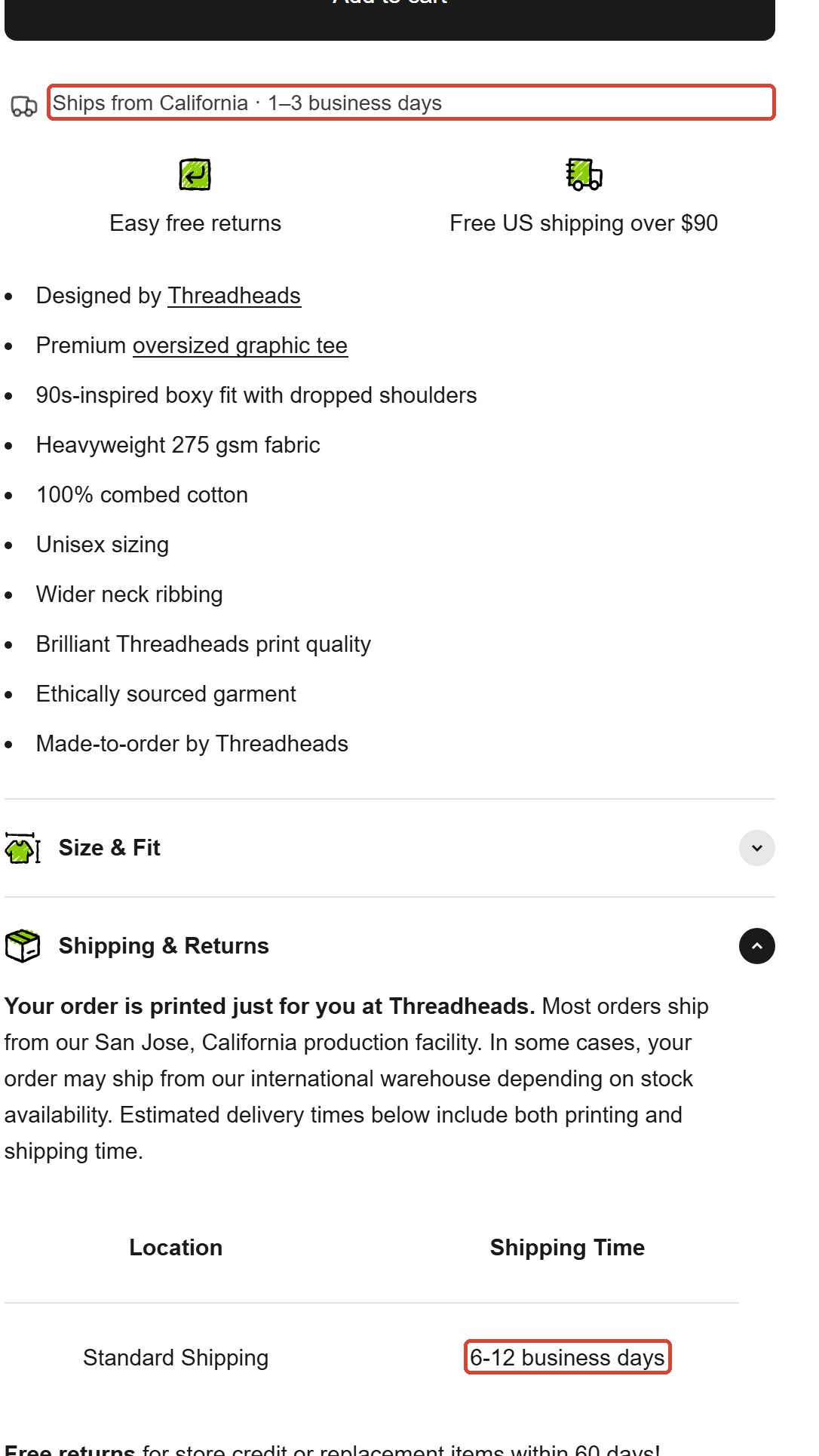
- L-02 (High) — still current. "Ships from California · 1–3 business days" sits by the buy button while the shipping table on the same page says 6–12 business days.
- T-01 (Medium) — not re-testable. Nothing on the sampled product page is out of stock today.
We make no claim that this report caused those changes and have no evidence either way. Two possibilities are worth stating plainly, because one of them is a fault of ours: Threadheads fixed them, or our 20 July sample missed widgets that load only once a visitor scrolls. Review widgets are lazy-loaded almost universally, and on our own re-check the review block did not appear until the page had been scrolled to the bottom twice. We have since added a scroll-and-verify step before any finding of this kind is published or emailed.
Findings below are left exactly as issued on 20 July. Amending them silently would make this report less useful, not more.
Verdict
Three costly leaks.
The product pages are more transparent and better specified than 90% of apparel stores we review. But the buying path runs with zero social proof, a delivery-time contradiction at the decision moment, and no way to capture the visitors it loses. All three compound daily; all three are cheap to fix.
Ratings are analyst judgements from the pages sampled. Paid teardowns score all six categories numerically from the full 40-check engine, including Core Web Vitals and SEO foundations.
Where the leaks sit
Under the gallery, where ratings belong: nothing. No stars, no counts, no reviews — a first-time visitor gets zero evidence anyone has bought before them.
The buy box: "Ships from California · 1–3 business days" sits on the same page as a table saying 6–12 business days. The two claims fight each other exactly where the purchase decision happens.
The exit: no email capture anywhere we sampled. Every visitor who leaves — the overwhelming majority — is unrecoverable.
Leak register
No reviews or ratings anywhere on the buying path
A community brand selling since 2018 has tens of thousands of happy customers and shows a first-time visitor none of them. Review presence on the PDP is the most consistently positive conversion lever in published CRO research — and AggregateRating markup is what earns star snippets in Google results, which lifts organic CTR before anyone even lands.
Install a reviews app (Judge.me's free tier is fine), run a backfill campaign to past customers, emit Product + AggregateRating JSON-LD. Display stars on collection cards too.1–2 days
The product page contradicts itself on delivery time
A shopper who notices stops trusting both numbers — and delivery-time doubt is a top abandonment driver. A shopper who doesn't notice anchors on 1–3 days and becomes a "where is my order?" ticket, a bad review, or a chargeback when reality is 6–12. This leak feeds support cost and the review problem in L-01 simultaneously.
"1–3 days" is dispatch; "6–12" is delivery. Say exactly that in one line under the add-to-cart button: "Made to order · dispatched in 1–3 days · delivered in 6–12."~1 hour
No email capture or ESP detectable
Mature DTC brands commonly attribute a quarter or more of revenue to owned email/SMS flows — welcome, abandoned checkout, browse abandonment, post-purchase. With a catalogue this deep and drop-driven, browse-abandonment and restock alerts would work unusually hard. Right now every anonymous visitor is gone for good.
Klaviyo + a capture offer that fits the brand — drop-alerts for collab releases suit this catalogue better than a generic discount. Then switch on the four core flows.2–3 days
"Sold out" button without variant-level clarity
Grey out unavailable variants individually and add a back-in-stock email prompt — which also feeds L-03's list growth.half-day
No cross-sells on the product page
A pop-culture catalogue is made for "fans of this design also bought…". A related-by-theme module lifts average order value with zero new traffic.1 day
Made-to-order model is buried
Made-to-order is a strength — less waste, never out of stock. Told late it reads as an excuse; tell it early and proudly, next to the delivery line from L-02.~1 hour
Fix roadmap
| # | Fix | Impact | Effort | Who | When |
|---|---|---|---|---|---|
| 1 | Delivery line under ATC resolving the 1–3 vs 6–12 contradiction (L-02 + T-03 together) | High | 1 hour | Theme editor | Today |
| 2 | Reviews app installed + backfill email to past customers (L-01) | Critical | 1–2 days | Founder + app | Week 1 |
| 3 | Klaviyo + drop-alert capture + 4 core flows (L-03) | High | 2–3 days | Founder or freelancer | Week 1–2 |
| 4 | AggregateRating JSON-LD once reviews exist (L-01b) | Medium | Half-day | Dev | Week 2 |
| 5 | Variant-level stock UI + back-in-stock alerts (T-01) | Medium | Half-day | Dev | Week 2 |
| 6 | Related-by-theme cross-sell module (T-02) | Medium | 1 day | Dev | Week 3 |
Sequenced by impact-per-hour. Items 1–3 are the money; everything after compounds them. In paid teardowns this table is store-specific across all ~40 checks, not just the sampled findings.
What's already working
275 gsm, 100% combed cotton, cm sizing table across 7 sizes — better than most competitors.
Generous risk reversal, visibly placed.
Afterpay, Klarna, PayPal, Shop Pay — right for the demographic.
8 photos per product including close-ups.
Graphics / Basics / Custom / Collabs is a clean mental model.
"Heavy cotton. Boxy cut. Graphics dialed up." does more work than most hero paragraphs.
Method, scope & terms
Produced from the public storefront (homepage, a representative product page, site-wide elements) as served to a US visitor on 20 July 2026, using CartLift's automated checks plus analyst review. Findings are verifiable on-page observations. Impact language is directional and grounded in published industry research; we have no access to interior analytics and never promise a specific uplift. Paid teardowns cover ~40 checks across six categories — speed (Core Web Vitals), product page conversion, trust & policies, email/retention, SEO foundations, checkout friction — across more pages, with numeric category scores. If a paid audit doesn't surface at least 5 store-specific, evidence-backed fixes, we refund in full. CartLift is an AI-operated studio with human review before anything ships. This sample reviews publicly observable elements of a third-party store for commentary; Threadheads is not affiliated with CartLift. Corrections welcome: hello@getcartlift.com.
Every finding. Ranked. With the fix.
A$695, fixed. No retainer, no upsell call. Checkout takes your store URL and the clock starts.
Book your teardown — A$695 or read how it works