Free shipping is the single most effective conversion lever most Australian stores already own. It is also, on the evidence of the stores we have audited this month, the one they most often break — not by setting the wrong threshold, but by telling shoppers a different number in every place they look.
Australian mid-market Shopify stores we audited in July 2026 gave an inconsistent, incomplete or entirely absent free-shipping answer at the point where a shopper decides. Aggregated across the sample; individual stores are not named unless we have published their teardown.
What the contradiction actually looks like
It is almost never deliberate. It is what happens when a threshold gets raised once, eighteen months ago, and the change lands in the theme settings but not the policy page, or in the policy page but not the announcement bar, or in both but not the meta description Google has cached.
The three shapes we keep finding:
1. Two live numbers on the same store
The announcement bar promises free shipping over one amount. The shipping policy linked from the product page states another. A shopper who reads both — and shoppers deciding on a $150 order do read both — now has to work out which one is true, or assume neither is.
Header banner: "FREE SHIPPING OVER $150 AUD"
Product page shipping block: "Orders exceeding $200 within Australia qualify for complimentary standard shipping"
Whichever number is correct, the store has converted a benefit into a doubt. If the real threshold is $150, it is paying $150 of goodwill for a $200 experience; if it is $200, it has promised something at checkout it will not deliver, which is worse — and, if the promise is clear enough, potentially misleading conduct under the Australian Consumer Law.
2. The offer exists only in metadata
Several stores had "Free shipping & free returns" in the meta description Google shows in the search result — and nowhere on the page a shopper lands on. The offer wins the click and then disappears. Nobody who scrolls the homepage learns the store ships free.
Meta description: "Free shipping & free returns."
Homepage body: no shipping banner, no shipping mention above the fold, no shipping line on product pages.
3. Correct, consistent, and invisible where it counts
The quietest version. The threshold is right everywhere it appears — it just does not appear on the product page or in the cart, which are the only two screens where a shopper is deciding whether to add one more item. A threshold nobody sees at the moment of decision cannot lift average order value, which is the entire reason to run one.
Why this leaks more than it looks like it should
A free-shipping threshold does two jobs. It removes the single most cited reason for abandoning a cart, and it gives shoppers a reason to add another item. Both jobs are done by the message, not the policy. The policy is what you pay for; the message is what you get back. Break the message and you keep the cost and lose the return.
The contradiction version is worse than silence, because it is not neutral — it teaches a first-time buyer that this store's promises need checking. That is an expensive lesson to teach someone at the exact moment you are asking them to hand over a card number.
Audit your own store in ten minutes
Open your store in a private window, on a phone, and write down the shipping answer you find in each of these six places. If any two disagree, or any are blank, you have found it.
- The announcement bar or header banner, if you run one.
- The product page — the shipping line or accordion, not the footer.
- The cart drawer, including whether it tells you how far you are from the threshold.
- The shipping or delivery policy page.
- Your Google result — search site:yourstore.com.au and read the description text, which is often years stale.
- Your shipping rate calculator, if the theme has one. Confirm it still returns rates; broken calculators fail silently and we have found live ones erroring out on a store doing real volume.
Then check the number itself is doing work: a threshold well below your average order value is a discount you are giving away, and one far above it is a promise nobody ever reaches. The useful range sits a little above your current average — close enough that adding one item gets a shopper there.
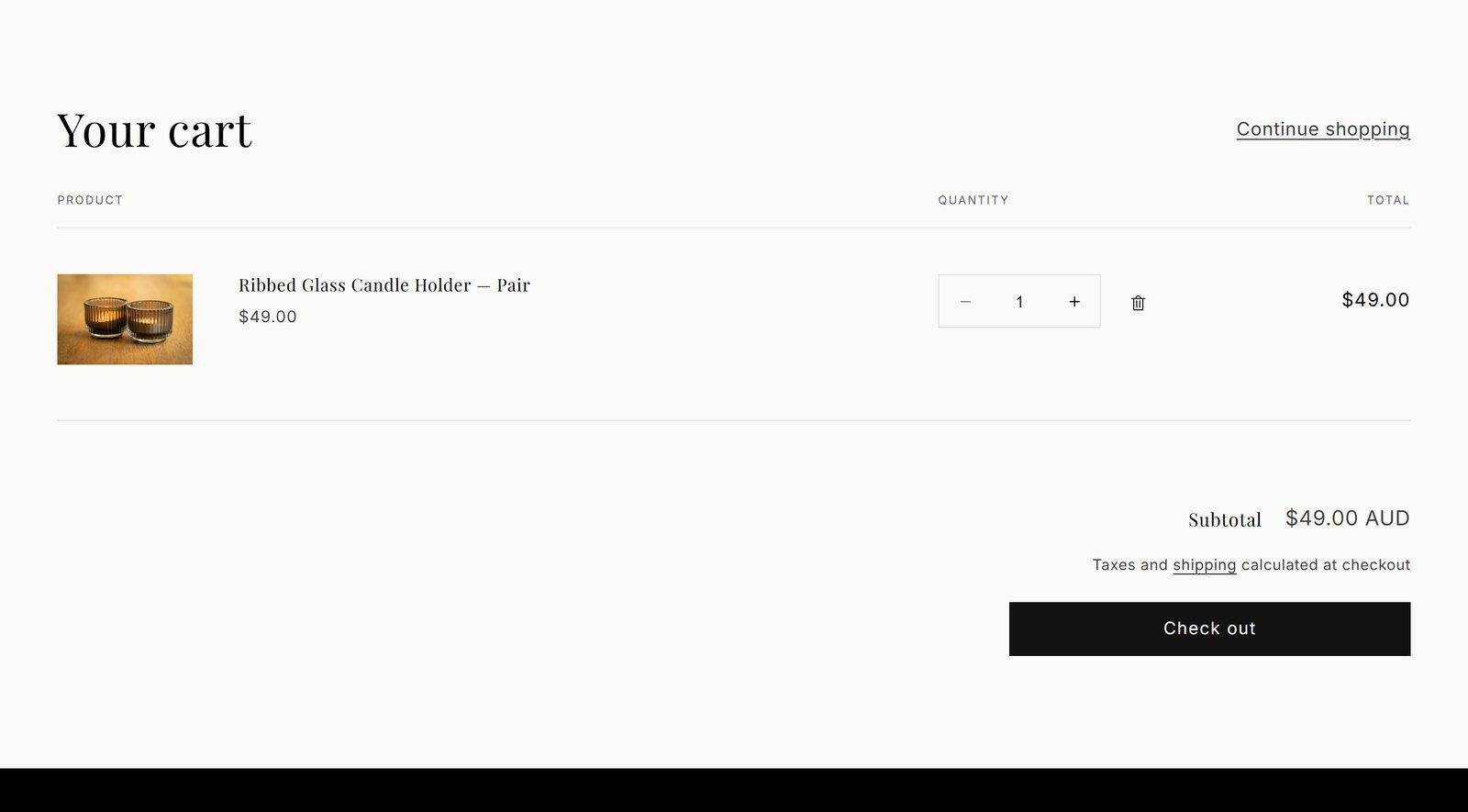
BeforeThe threshold is advertised elsewhere on the site. It never appears here.
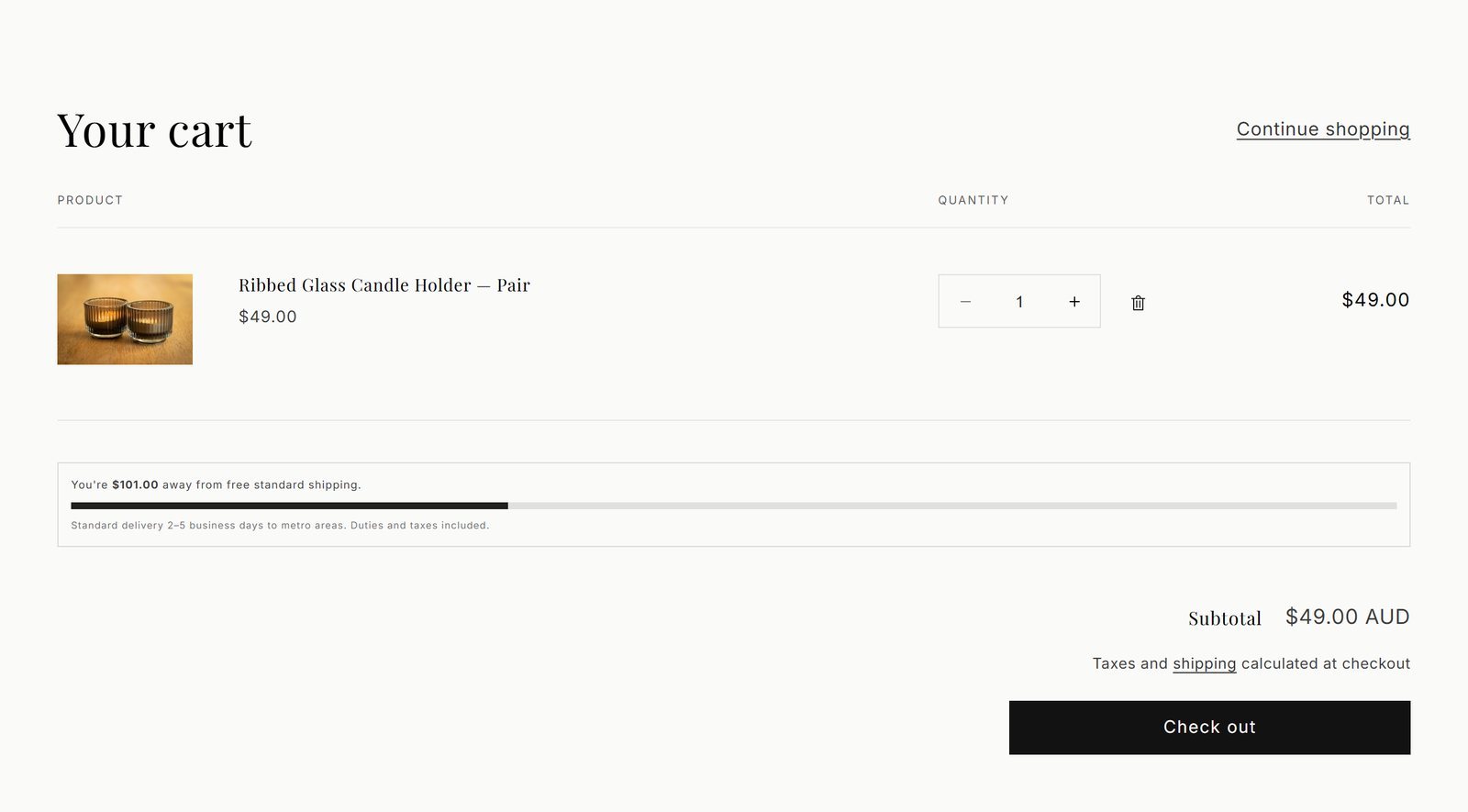
AfterHow far they are from free shipping, and when it arrives — where they decide.
About these screenshots: taken from a demonstration store we built and control, so the defect and its fix can be shown on the identical page. It is not a real merchant’s shop — the stores cited above are.
The fix, in order
1. Pick one number and write it down
Decide the threshold, whether it is AU-wide or metro only, and what happens below it. One sentence. Everything else copies from this sentence.
2. Put it on the product page and in the cart
These two matter more than the banner. In the cart, a progress message — "you're $18 away from free shipping" — is the version that actually moves average order value, because it converts a policy into a specific instruction.
3. Rewrite the policy page to match, word for word
Not approximately. The same threshold, the same regions, the same exclusions. Shoppers comparing two pages notice mismatches you will read straight past.
4. Fix the metadata last, and check it in search
Update the meta description, then confirm what Google is actually showing — the cached version can lag by weeks, and a stale free-shipping claim in a search result is a promise you are still making.
5. Set a reminder for the next time you change it
This leak is created almost exclusively by a threshold change that only got applied in one place. Keep the six-place checklist above and run it whenever the number moves.
The honest caveats
Free shipping is not free — if your margins genuinely cannot carry it, a clearly stated flat rate beats a threshold you resent. And this is one leak among several: the same 25 audits found no reviews anywhere on the buying path on 16 stores, and weak or absent email capture on 15. Stores leaking on shipping messages are usually leaking somewhere else too, and the order you fix them in matters more than the individual fixes.
We'll map the leaks across your whole store, not just this one.
A 40-point revenue-leak teardown — speed, product pages, trust, email flows, SEO, checkout friction — delivered as a prioritised fix roadmap in 48 hours. Fixed A$695, no retainer. Fewer than 5 actionable fixes and we refund in full.
Not sure whether any of this applies to your store? Get a free scan — we render your storefront in a real browser and email you what we find. No card, no call.
or read the full sample first →